What NZEB Means for Real Estate Projects in Romania
8 December 2025 • Imobiliare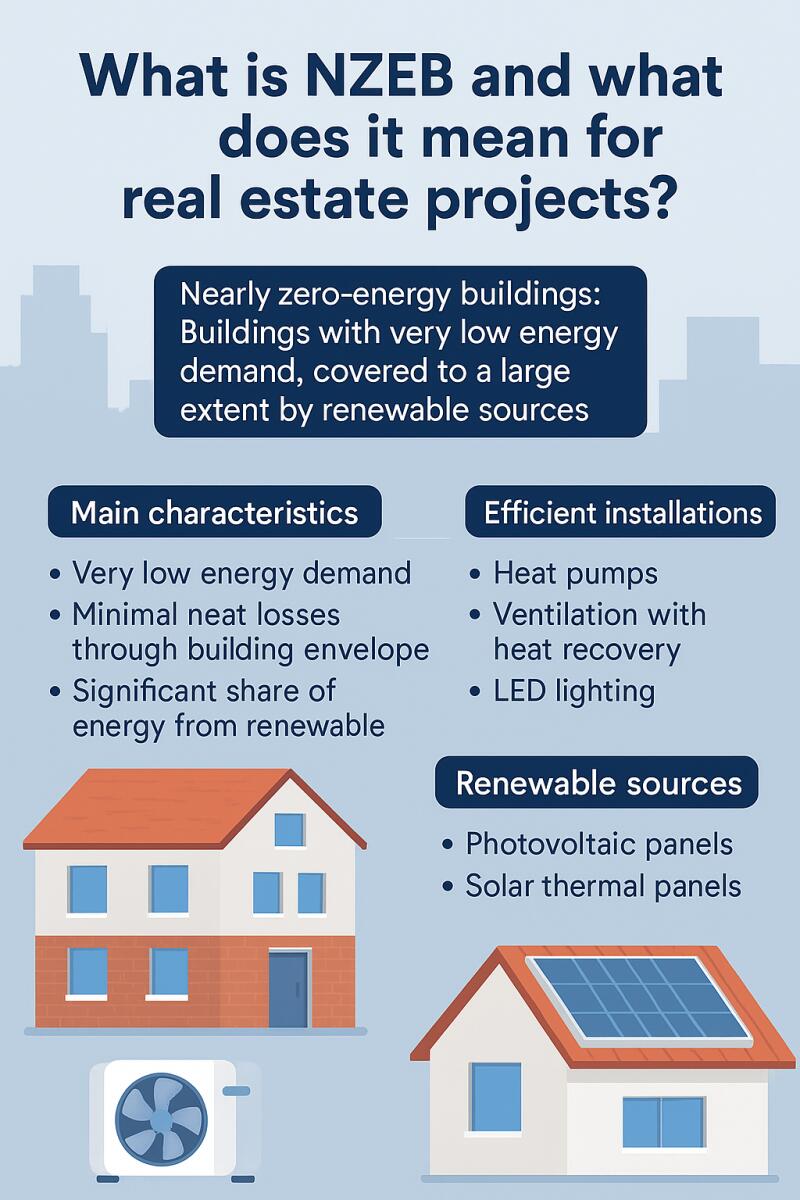
A complete guide to the NZEB standard, how it applies in Romania, its impact on new and ongoing developments, and what investors and developers must understand to stay competitive.
What NZEB Means for Real Estate Projects in Romania
Introduction to the NZEB concept
NZEB (Nearly Zero Energy Building) refers to buildings with extremely low energy consumption, covered largely by renewable sources. In Romania, NZEB compliance has been mandatory for new building permits issued after 2021. This requirement is reshaping the market, affecting both development costs and long-term operational efficiency.
For investors and developers, NZEB is no longer optional. It directly affects pricing, marketability, demand, and financing options, making it one of the most significant shifts in the Romanian property sector.
Why NZEB was introduced in Romania
The introduction of NZEB stems from the European Union’s long-term strategy to reduce energy consumption, lower carbon emissions, and increase building resilience. With rising energy prices and growing demand for efficient housing, NZEB has become both a regulatory obligation and a commercial differentiator.
Core characteristics of NZEB buildings
NZEB buildings rely on three structural pillars:
- Highly efficient thermal envelope
- advanced insulation (walls, roofs, floors);
- triple-glazed or equivalent high-performance windows;
- minimization of thermal bridges;
- improved airtightness.
Efficient mechanical and electrical systems
- heat pumps (air-water or ground-source);
- mechanical ventilation with heat recovery;
- LED lighting and low-consumption systems.
Renewable energy contribution
- photovoltaic panels;
- solar thermal systems;
- integration of green energy into the building’s energy balance.
What NZEB means for ongoing construction projects
Projects authorized before NZEB became mandatory
Although they are not legally required to comply, these projects face significant commercial challenges:
- lower market appeal;
- higher operational costs for future owners;
- competitive disadvantage compared to new NZEB developments;
- potential financing limitations from banks prioritizing efficient buildings.
Many developers choose to retrofit NZEB elements voluntarily to avoid these disadvantages.
Projects currently under construction
Developments in execution can integrate NZEB components, but this often requires:
- redesigns and recalculations;
- increased budgets;
- technical upgrades;
- collaboration with energy-efficiency consultants.
Typical upgrades include:
- replacing gas boilers with heat pumps;
- adding ventilation with heat recovery;
- installing photovoltaic systems for common areas;
- improving insulation beyond the original plan.
What NZEB means for future developments
Mandatory technical requirements
All projects seeking building permits must comply with NZEB criteria. This includes:
- strict energy performance thresholds;
- renewable energy contribution requirements;
- high-efficiency HVAC systems;
- detailed energy modeling and documentation.
Financial implications
Although NZEB construction costs are higher (5–15%), long-term savings are substantial, with 30–60% reduction in operational costs.
Benefits for developers:
- increased project value;
- faster sales absorption;
- better positioning against competition;
- access to green financing and incentives.
Benefits for investors:
- stable, predictable returns;
- lower operational expenses;
- higher tenant demand;
- reduced long-term depreciation.
Why buyers prefer NZEB buildings
End-users increasingly prioritize:
- low utility bills;
- comfort and temperature stability;
- clean indoor air;
- partial energy independence;
- long-term protection against rising energy costs.
Energy efficiency has become a decisive purchase factor in the mid and upper segments.
How NZEB affects pricing
Despite higher construction costs, NZEB buildings often sell at a 5–10% premium due to their superior long-term value. Moreover, NZEB units typically sell faster than non-compliant ones.
Challenges for developers
Implementing NZEB presents hurdles:
- more complex design phases;
- higher equipment costs;
- integration of renewable energy systems;
- need for specialized engineering expertise.
However, these challenges are offset by improved competitiveness, better financing options, and higher customer satisfaction.
Conclusion
NZEB represents the future of Romania’s real estate development. Developers who adapt will lead the market with efficient, attractive, and valuable projects. Buyers benefit from lower costs and higher comfort, while investors gain stability and resilience.
In an increasingly competitive market, projects that fail to adopt NZEB standards risk obsolescence, while those that embrace them will set the benchmark for the next decade.