Romania's Population Stabilizes Near 19 Million as Immigration Offsets Decline
31 August 2026 • Știri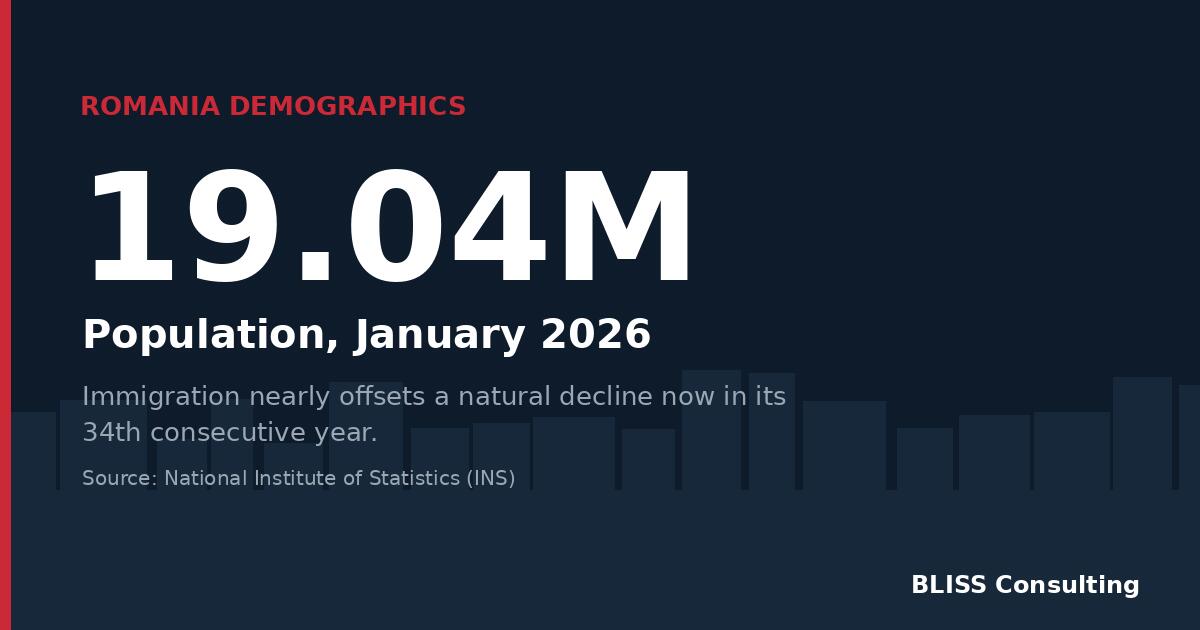
This article is for informational purposes only and does not constitute legal, tax, or financial advice. For specific situations, consult a qualified professional.
Romania's resident population stood at 19.041 million on 1 January 2026, according to data published by the National Institute of Statistics (INS). This represents a decrease of just 1,829 people compared with the start of 2025 — a marginal change that conceals a much larger underlying shift in the country's demographic makeup.
This article outlines the latest population figures, the role immigration now plays in offsetting natural decline, and how Romania's age structure continues to evolve.
A Small Net Change Driven by Two Opposing Forces
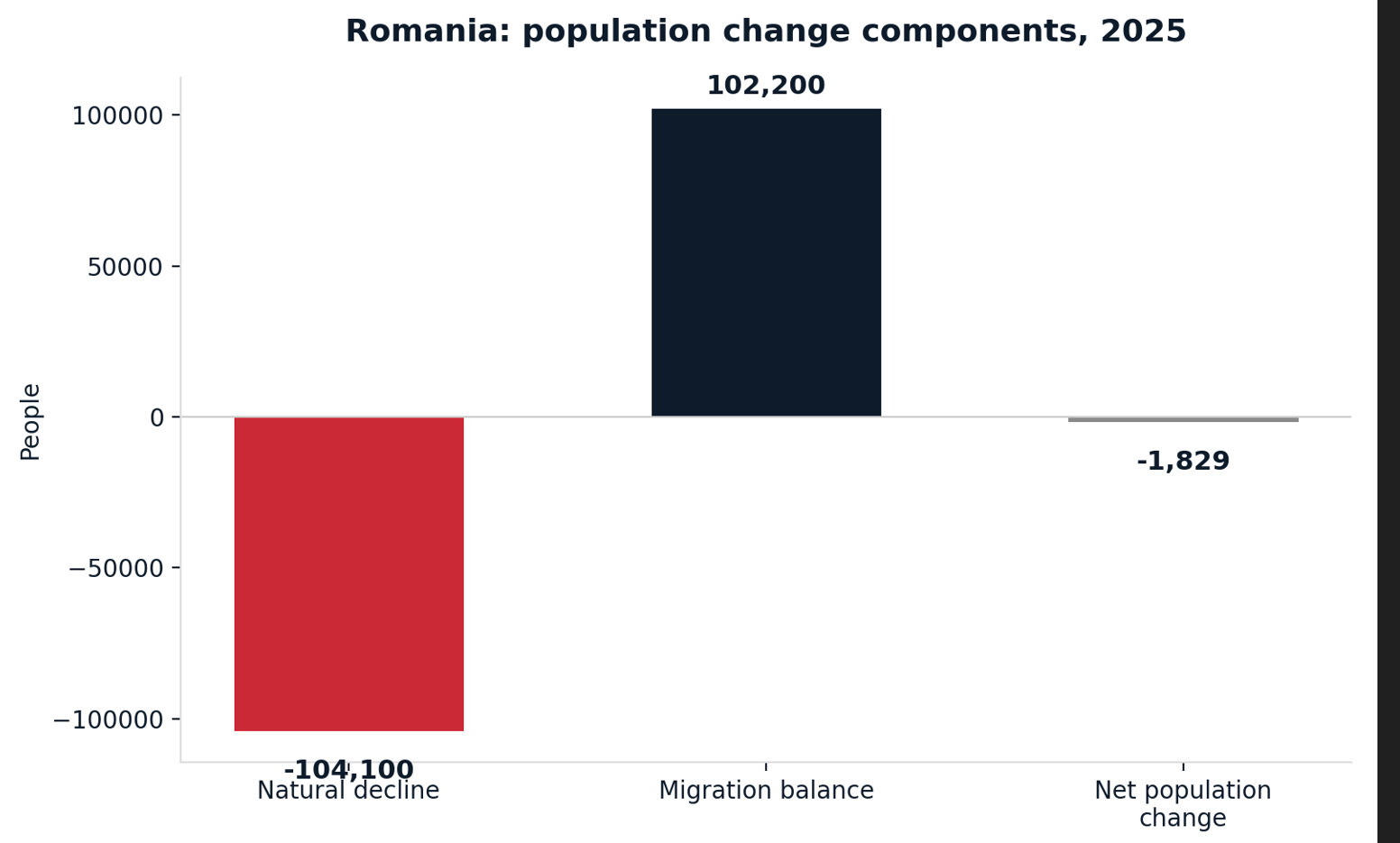
Romania recorded negative natural population growth — meaning deaths exceeded births — of 104,100 people in 2025. This marks the 34th consecutive year of negative natural growth, a trend that has continued uninterrupted since 1992.
At the same time, international migration moved firmly in the opposite direction. Romania recorded a positive migration balance of 102,200 people in 2025, as the number of immigrants exceeded the number of emigrants. This balance nearly, but not entirely, offset the natural population loss, resulting in the small net decline recorded for the year.
Immigration as Romania's Demographic Buffer
The 2025 figures confirm Romania's continued shift toward becoming a country of net immigration rather than net emigration — a reversal of the pattern that characterized much of the post-1990 period.
- Migration composition: Men accounted for 57.9% of emigrants and 58.6% of immigrants in 2025.
- Scale of the balance: A migration surplus of 102,200 people was large enough to nearly cancel out a natural decline of 104,100 people.
Urban Population and Gender Distribution
Romania's urban resident population reached 9.792 million at the start of 2026, up 0.2% compared with 1 January 2025. The female population stood at 9.744 million, down 0.1% year-on-year.
An Aging Population Structure
Beyond the headline population figure, INS data points to a continued shift toward older age groups.
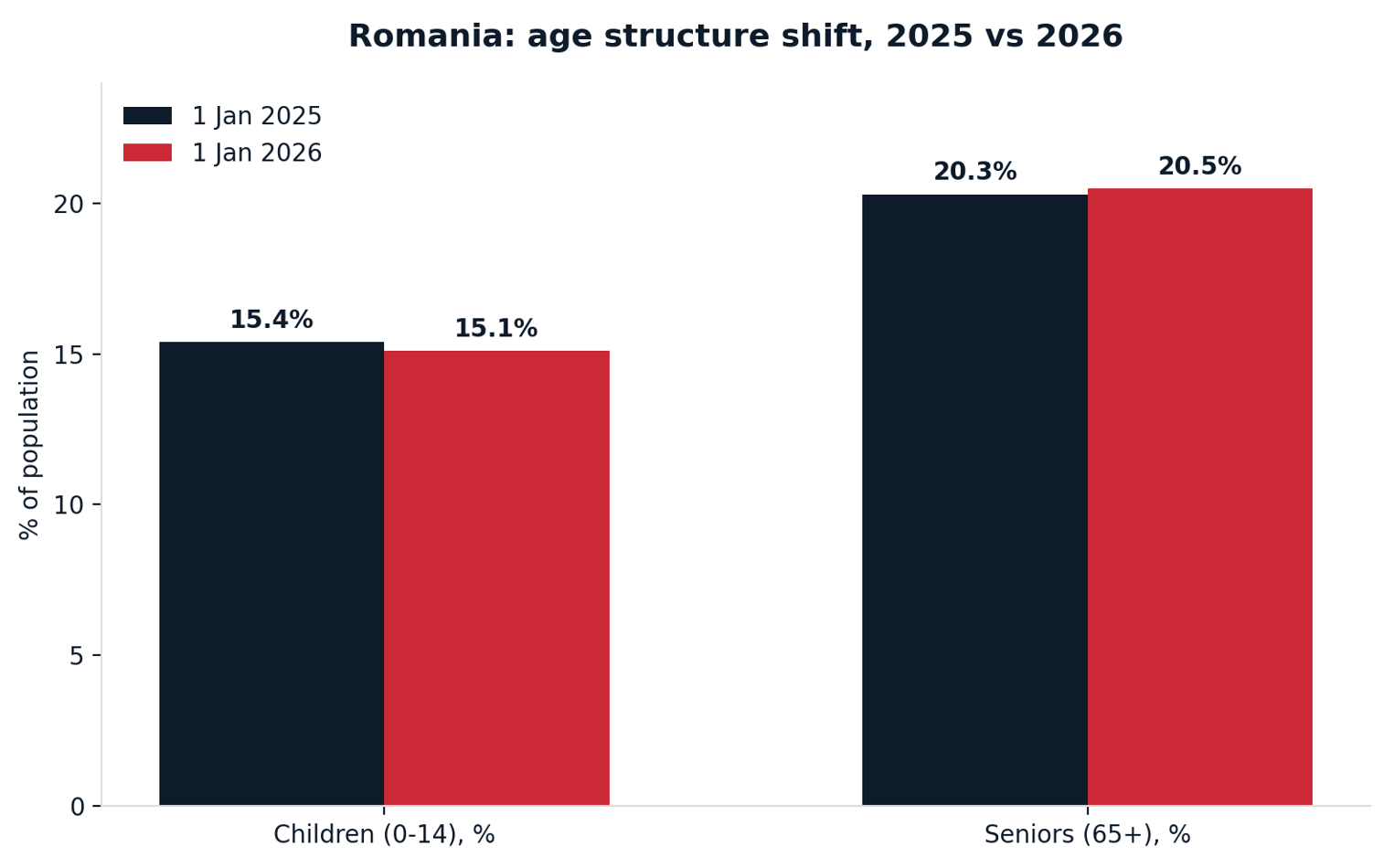
- Older population share: People aged 65 and over represented 20.5% of Romania's resident population on 1 January 2026, up from 20.3% a year earlier.
- Younger population share: The share of children aged 0–14 declined from 15.4% to 15.1% over the same period.
- Ageing index: The ratio of people aged 65+ to every 100 people aged 0–14 rose from 131.3 to 135.9.
- Dependency ratio: The number of young and elderly people per 100 working-age adults eased slightly, from 55.6 to 55.2.
How the Figures Are Defined
INS defines the resident population as all Romanian, foreign, and stateless persons whose usual residence is in Romania for at least 12 months. This includes people who have immigrated to the country and excludes those who have emigrated. Ukrainian citizens benefiting from temporary protection during the war in Ukraine, and meeting the residence criteria, are also included in the estimate.
The population figures for 1 January 2026 are provisional and are due to be revised by INS in December 2026.
Conclusion
Romania's population has remained broadly stable at close to 19 million, but the composition behind that stability continues to shift: fewer births relative to deaths, a growing reliance on immigration to hold the population steady, and a structurally older population overall. These are the kinds of underlying demographic dynamics that shape long-term market fundamentals in Romania.
BLISS Consulting monitors demographic, regulatory, and market data relevant to Western European investors and entrepreneurs active in Romania.
Get in touch: 0040 729 005 625 | [email protected] | blissconsulting.ro
Source: Business Review