Corbu, Constanța - The Coastal Zone Guide for Investors and Those Looking for Something Different
30 March 2026 • Real estate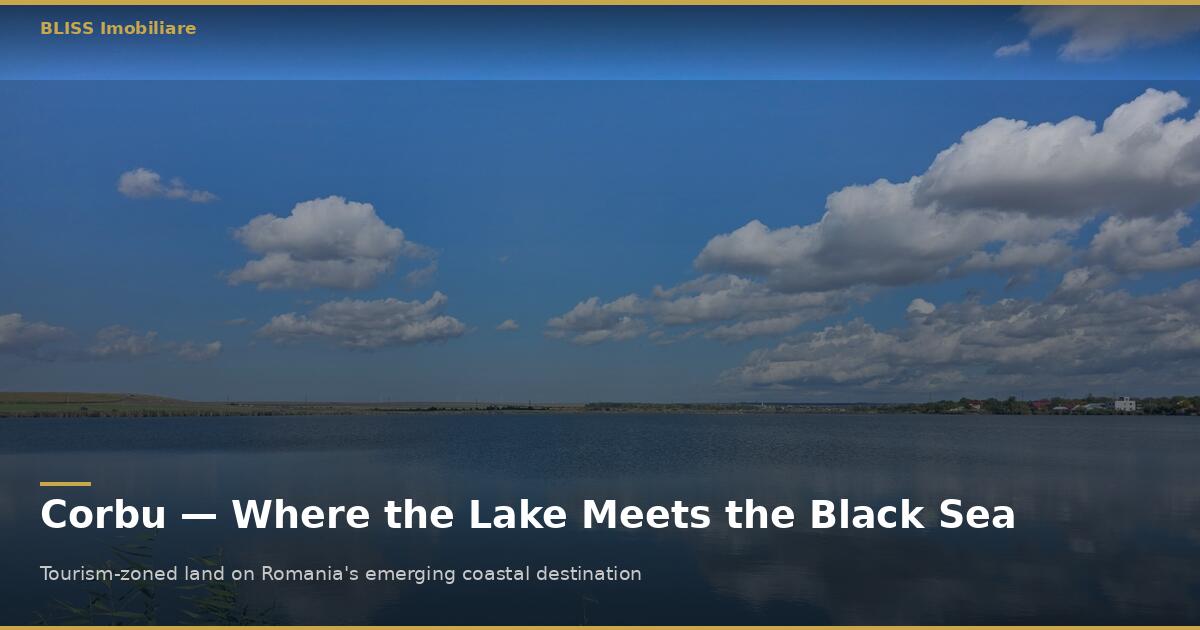
Corbu — The Coastal Destination Romania Has Not Yet Discovered | Between Lake Corbu and the Black Sea — A Natural Setting Without Equal on the Coast
Corbu, Constanța — What It Is, What It Looks Like and Why It Matters
There are places on Romania's coastline that you know by name without ever having seen them. Corbu is one of them. It does not appear in holiday advertisements, it has no chain hotels, it has no July crowds. It has something else — and that is precisely its value.
This article is not selling anything. It describes a place. What Corbu is, what it actually looks like, what it offers those who arrive there, and why it has begun to appear in the calculations of those looking for something on the coast that Mamaia has long been unable to provide.
Lake Corbu — The Element That Changes Everything
The first surprise for anyone arriving in Corbu is the lake.
Lake Corbu is a natural coastal lake, separated from the Black Sea by a narrow strip of land. Its wide surface, the stillness of the water and the reed beds along its banks create a landscape that resembles nothing else on the Constanța coastline. It is not a landscaped lake, not a park. It is a natural ecosystem — with birds, reflections and a quality of silence that crowded beaches cannot imitate.
For a tourism project, this combination — natural lake plus the Black Sea a few minutes away — is a genuine product advantage. Guests do not have to choose between the lake and the sea. They have both.
The Black Sea a Few Minutes Away
Corbu beach is one of the few undeveloped beaches remaining on Romania's coastline. Sandy, wide, without rows of sun loungers and without music from speakers. Access is straightforward, the distance from the village is short.
It is not a resort beach. It is a real beach — and for an increasingly large segment of Romanian and European tourists, this is exactly what they are looking for. The trend toward authentic, undeveloped tourism in direct contact with nature is not a passing fashion. It is a structural shift in preferences that accelerates every season.
What Low Density Actually Means in Practice
Corbu is a commune with permanent residents, not a resort built for the season. That means several concrete things:
- The main road functions all year round, not only in July and August
- There is a real local community, not a seasonal infrastructure
- Buildable land still exists — unlike Mamaia or Năvodari, where supply is practically exhausted
- A tourism project built now does not compete with dozens of similar ones — it defines the standard of the area
Low density is not a marketing disadvantage. It is a structural advantage for anyone who enters first with a well-positioned product.
Accessibility — How to Get to Corbu
Corbu is located in Constanța County, approximately 25 km north of Constanța city and a short distance from Năvodari. Access is via DN2A and county roads.
- From Bucharest: approximately 2.5 — 3 hours by car, depending on traffic
- From Constanța: approximately 30 minutes
- From Năvodari: under 15 minutes
It is not an isolated destination. It is a quiet destination — and the difference between the two matters enormously for the profile of tourist who will choose it.
Who Comes to Corbu and Why They Come Back
The current visitor profile in Corbu is not the mass tourist seeking entertainment and terraces. It is:
- The family that wants space, quiet and nature without sacrificing accessibility
- The cyclist, birdwatcher, kayaker — the active nature user
- The Romanian from the diaspora looking for something authentic when returning home
- European tourists discovering Romania's coastline as an accessible alternative to Mediterranean destinations
- The investor who understands that demand for this profile of destination is growing, not declining
This visitor profile has greater purchasing power than the coastal average, stays longer, consumes locally and returns. It is exactly the type of tourist that a boutique project targets.
What Is Still Missing — and Why That Is the Opportunity
Corbu does not yet have the tourism infrastructure it deserves. There are no boutique hotels. There are no guesthouses with a clear identity. There are no restaurants that make use of local produce and the natural setting of the lake.
This is simultaneously the current limitation and the structural opportunity.
Any well-conceived and well-positioned tourism project that enters Corbu now is not entering a saturated market. It is entering a market in formation — with the advantage of defining the standard rather than following it.
The moment when tourism infrastructure catches up with demand is the moment when the entry price doubles. Corbu has not reached that point yet.
Conclusion
Corbu is not a destination for everyone. It is a destination for those who know what they are looking for — quiet, nature, authenticity and real space. And for investors who understand that these qualities are increasingly rare and increasingly valuable on a coastline that has been built haphazardly over the last three decades.
An undiscovered place does not stay undiscovered forever. The question is who gets there first.
Frequently Asked Questions
1. Is Corbu accessible year-round or only seasonally?
Corbu is a commune with permanent residents, not an exclusively seasonal resort. Access roads are functional all year. Basic services — food store, road access, utilities — are available outside the season. The seasonal nature of tourism does not equate to isolation in the off-season.
2. What activities are available in the area?
The area offers natural undeveloped beach, fishing, birdwatching in the lake and reed bed zone, cycling on low-traffic roads and nature walks. There is no organised resort-level leisure infrastructure — which is simultaneously a present limitation and a clear development opportunity.
3. How far is the beach?
Corbu beach is a few minutes by car from the centre of the village. It is a natural, undeveloped beach with sand and direct access — without commercial beach infrastructure in the conventional sense.
4. Are there schools, shops and medical services nearby?
Corbu has basic services appropriate for a commune of this size. For extended services — international schools, hospitals, shopping centres — Năvodari and Constanța are a short distance away. The user profile of a tourism project in Corbu does not require all of these services to be within the village.
5. How do you get to Corbu from Bucharest?
Approximately 2.5 — 3 hours by car via the A2 motorway and DN2A, depending on traffic. There is no direct train or express bus connection — private car or private transfer are the practical options for this destination.
6. Why Corbu and not Năvodari or Mamaia?
Năvodari and Mamaia are destinations with consolidated tourism infrastructure, high entry prices and a supply of land that is practically exhausted. Corbu offers what those destinations can no longer provide: space, quiet, an intact natural setting and an entry point into a market that has not yet reached its potential. They are different destinations for different investor and tourist profiles.
Contact
The land presented in this article is listed exclusively by BLISS Consulting. For full details, documentation and viewings:
Email: [email protected]
Phone / WhatsApp: +40 729 005 625
View the full property listing:
https://blissimobiliare.ro/en/land-for-sale-litoral-black-sea-coast-romania-comuna-corbu-judetul-constanta-romania-906252
Read also: Land for Sale in Corbu — Tourism-Zoned Coastal Investment on the Black Sea