Premium Class A Offices for Rent in Romania – A Complete Tenant Guide
27 October 2025 • Investments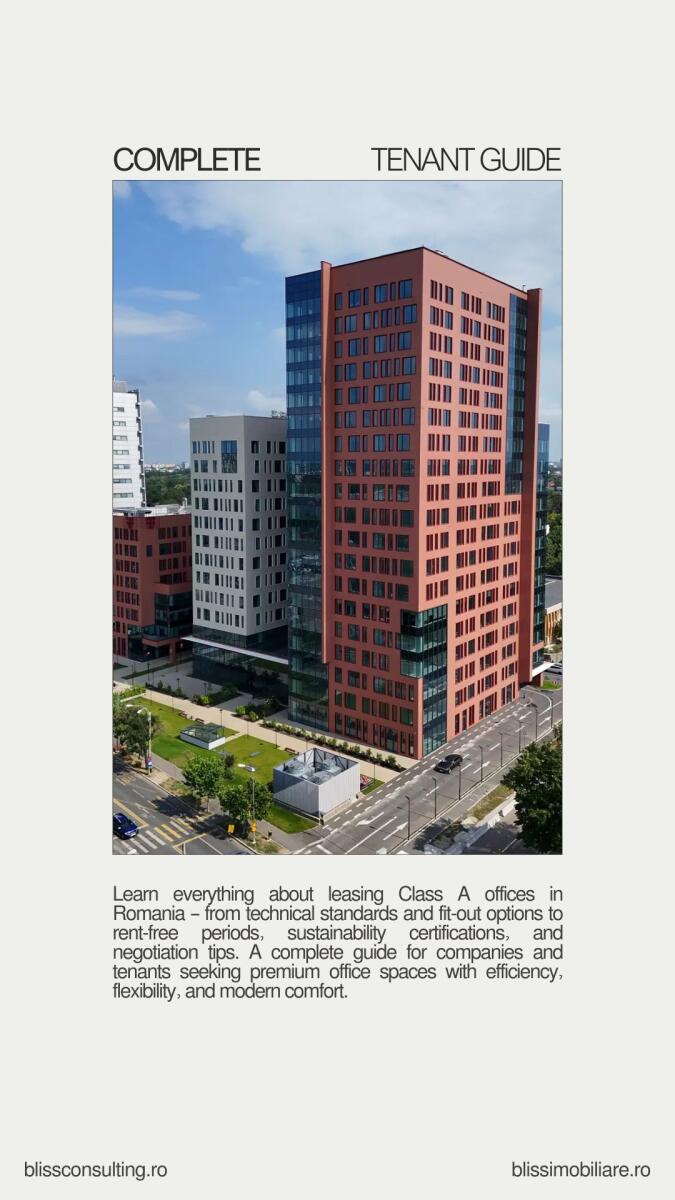
For personalized corporate office consultancy:
BLISS Consulting | Corporate Leasing & Tenant Representation
- [email protected]
- +40 729 005 624
Premium Class A Offices for Rent in Romania – A Complete Tenant Guide
Renting the right office space is not just about finding a modern building — it’s about understanding all the technical, contractual, and financial details that define an optimal choice.
This guide helps you understand what a Class A office truly means, the key stages of the leasing process, and how to negotiate effectively so that your company secures the best balance between cost, comfort, and brand image.
What Defines a Class A Office Building
Class A office buildings represent the premium segment of the Romanian commercial real estate market.
They are designed to offer:
- Prime locations with easy access to public transport (metro, tram, main roads)
- Operational efficiency, with large and flexible floorplates
- Modern technology – HVAC systems with 100% fresh air, zoned temperature control, and LED lighting
- Green certifications (BREEAM, LEED, WELL)
- Integrated amenities such as underground parking, showers, green areas, restaurants, gyms, and EV charging stations
- Contemporary design and representative common areas that enhance a company’s corporate image
Delivery Conditions – What Tenants Can Choose
Depending on the fit-out stage, office spaces can be delivered in three main conditions:
1. Shell & Core
- The basic structure of the building (walls, main installations, ceiling, raw flooring)
- Ideal for large tenants who want a fully customized fit-out from scratch.
2. Warm Shell
- Includes full infrastructure, HVAC, basic lighting, raised floor, and suspended ceiling.
- Best suited for companies seeking design flexibility without investing heavily in mechanical or electrical systems.
3. Fully Fitted
- A ready-to-use office, already fitted and furnished — ideal for quick occupancy, with no additional fit-out costs.
Understanding the Total Cost of Occupancy
When analyzing a lease proposal, always consider all cost components, not just the base rent.
- Monthly (OPEX)
- Base Rent: €/m²/month
- Service Charge (CAM): €/m²/month (maintenance, security, cleaning, reception, common utilities)
- Utilities: electricity, water, out-of-hours HVAC
- Parking: €/space/month
- Annual Indexation: according to HICP / Eurostat
- Initial (CAPEX)
- Fit-out, furniture, branding
- Security deposit (1–3 months’ rent + CAM)
- Technical consultancy, permits, relocation costs
Negotiating these components transparently is key to understanding the true cost of occupancy.
The Leasing Process – Key Steps
- Define internal needs – headcount, hybrid ratio, budget, preferred area
- Market scan and shortlist – 3–5 most suitable buildings
- Viewings and test-fits – evaluate layouts and density
- RFP (Request for Proposal) – send standardized requests to landlords
- Compare offers (scoring matrix) – rents, CAM, terms, benefits
- Commercial negotiation (BAFO) – rent-free, fit-out contribution, duration, indexation
- Head of Terms / Lease Agreement – legal and technical negotiation
- Fit-out & move-in – design, permitting, works, final handover
Typical timelines:
- 3–6 months for Fully Fitted spaces
- 6–9 months for Warm Shell
- 9–12 months for Shell & Core
Key Contractual Clauses
- Lease term (usually 3–5 years)
- Renewal & break options
- Annual indexation mechanism
- Fit-out contribution or rent-free period
- Make-good clause (restoration at end of term)
- Sublease / assignment rights
- Service charge cap (where applicable)
- Out-of-hours usage & related costs
A professional real-estate consultant can help you optimize these clauses, mitigating hidden costs and operational risks.
ESG, Sustainability and Wellbeing
More and more multinational tenants are prioritizing BREEAM, LEED or WELL-certified buildings, which provide:
- Lower energy consumption and reduced operating costs
- Superior air and daylight quality
- Thermal and acoustic comfort
- Facilities for cyclists, showers, EV chargers
- Green areas and relaxation zones
These criteria are no longer just “nice to have” — they have become key factors in talent retention and an integral part of corporate ESG strategies.
How to Negotiate Effectively
- Request a complete written offer and a free test-fit.
- Review the service charge breakdown (security, cleaning, HVAC, admin).
- Verify fit-out costs and any landlord contribution (TI).
- Negotiate rent-free periods (1–6 months typical).
- Include expansion / contraction options where possible.
- Clearly define the make-good obligations at lease end.
Why Work with a Tenant Representative
Romania’s office market has matured significantly, offering a wide range of Class A and A+ options across Bucharest and major cities.
Yet, the differences between projects — from technical quality to contract terms — can have a major impact on total occupancy cost and long-term flexibility.
Partnering with an experienced consultant such as BLISS Consulting helps you:
- Conduct a transparent, data-driven comparison of all available options
- Negotiate the best commercial and legal terms
- Manage the fit-out and technical coordination process
- Represent your company’s interests professionally in front of landlords
Final Takeaway
Leasing a Class A office is not just a real-estate transaction — it’s a strategic business decision that influences your company’s culture, talent retention, and operational efficiency.
With careful planning, experienced consultants, and smart negotiation, any tenant can secure a workspace that perfectly balances value, performance, and brand impact.